
Rain gardens

 Last year I wrote a blog on green roofs, so today I want to follow up with a much smaller and more versatile type of green infrastructure, the rain garden, sometimes called a bio-retention cell. These can be introduced into a small corner of your garden and have even been used as slightly modified planters along roadways where there is not enough space for a more extensive vegetated installation such as a swale.

File:Planted brick swale, balfour street pocket park.JPG - Wikimedia Commons
A vegetated swale
Creative Commons Licensed: 
https://commons.wikimedia.org/wiki/File:Planted_brick_swale,_balfour_street_pocket_park.JPG
One of the most severe environmental impacts of urbanisation is that the porous soil and vegetation of the natural landscape is replaced by impermeable materials for buildings and roadways. This prevents rainwater from seeping into the soil and replenishing the groundwater (the water naturally stored underground) and becoming cleaned by percolating through the plants and soil before returning to the natural water courses. In urban areas, the storm-water is channeled into a piped system, which causes flooding when it is overloaded, and the pollution that accumulates on surfaces, such as oil on roadways, is washed into the pipes and onwards to rivers, lakes and eventually into the sea.

Green infrastructure imitates nature as far as possible, often taking on even more of the role of water permeation and pollution removal as a small area of vegetation now needs to do the job of the much bigger area taken up by a building or roadway. A rain garden is the smallest of these and can be fitted into a tiny space, as little as one metre in diameter. 
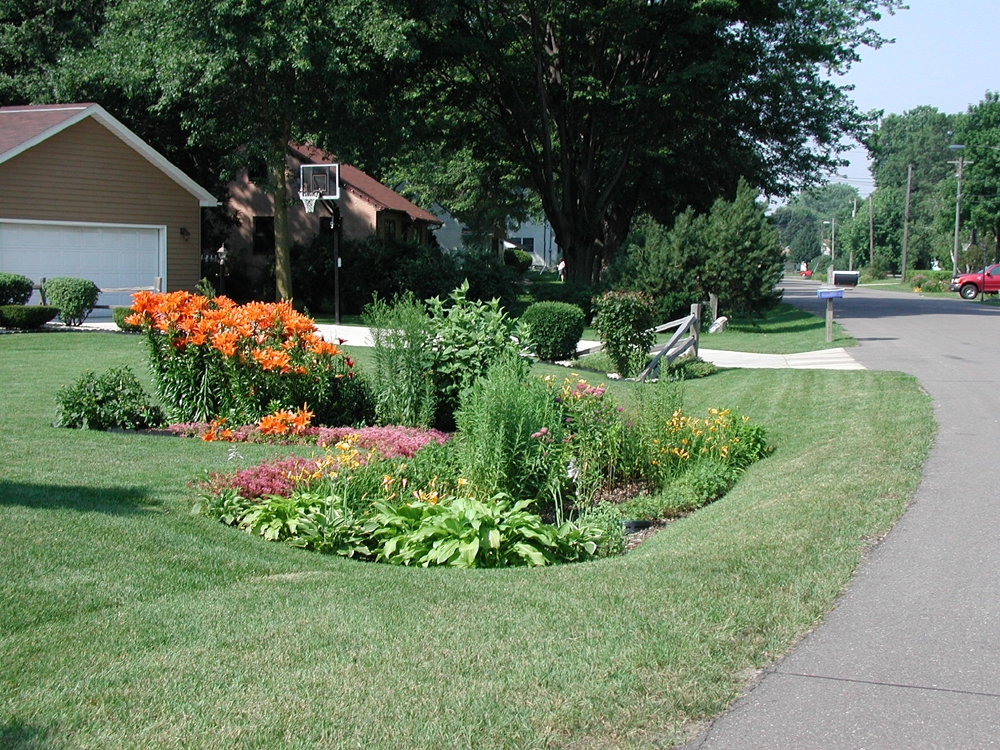
How Do You Build a Beautiful Rain Garden at Home?
A well-established rain garden
Creative Commons Licensed: 
https://homedecomalaysia.com/how-do-you-build-a-beautiful-rain-garden-at-home/
The principle of a rain garden is to direct the runoff (from a roof or paved area) to a point that is lower than the surrounding landscaping, where it can briefly form a pond before percolating the rain-water into the ground. For this reason, it is normally located close to a rain-water spout or down-pipe, but ideally this should be extended so that the rain garden is about a meter away from the wall of the building to prevent rising damp.

File:2006NeighborsNewRG2.JPG - Wikimedia Commons
A newly installed rain garden with extended rain-water spout
Creative Commons Licensed: 
https://commons.wikimedia.org/wiki/File:2006NeighborsNewRG2.JPG
To construct a rain garden, you first need to dig a hole the area of the planned planting and about 60 to 75 cm deep. Keep the topsoil on one side, as you can re-use it when backfilling. Loosen the ground at the bottom of the hole, and then put down a layer of stones or clean broken bricks to form a permeable layer about 10 cm deep. Mix the topsoil and some of the soil taken from lower down with some compost or potting soil - you will want less material than you dug out of the hole, as the final level of the rain garden needs to be about 10 cm lower than the surroundings.

Choose plants that are water-loving, but preferably quite hardy, so that you don't have to water them in the dry season. My favourite for all green infrastructure in Johannesburg is plectranthus neochilus, as it loves plenty of water but is very hardy in our dry winters.

If you are doing new paving near the rain garden, here is a great opportunity to channel the runoff into the garden rather than into a roadway or storm-water outlet. Try to give the paving a very gentle gradient, so that the water will flow quite slowly into the garden and prevent erosion. 

You may find, after you have completed the garden, that your rain-water outlet is scouring away the soil, so you may want to install a splayed outlet to disperse the water. Alternatively you may be able to fashion a spray to the end of the outlet using a plastic bottle cut in half with holes in the bottom similar to a showerhead. 

Your rain garden, unlike many other types of green stormwater installations, does not need any special maintenance, just the normal trimming and tidying that you would do for a normal flowerbed. Once a year, just before the rainy season, it is good to loosen the soil around the plants to encourage drainage. At the same time, you can place mulch around the plants but this is not essential.


Comments

Popular posts from this blog

Welcome to my blog

Sitting outside the Wits Architecture Building My name is Anne. I have just retired from the University of the Witwatersrand in Johannesburg, South Africa where I was an Associate Professor in the School of Civil and Environmental Engineering, working in the environmental engineering and project management domain. Prior to that, I was a lecturer in the School of Architecture and Planning, teaching many aspects of architecture, including architectural history, design and skills in graphics. Before lecturing at the University, I worked briefly in local government as a junior architect and then in a commercial firm of architects. After this I ran a private architectural practice with a focus on architectural heritage design. I have qualifications in architecture, construction management and employment creation through construction. Now that I have retired, I want to continue to provide educational context about architecture, engineering, design and project management in a different forum ...

Useful and beautiful

  Have nothing in your houses that you do not know to be useful or believe to be beautiful. (William Morris) Morris was born in 1834 and lived through one of the most profound changes in design and manufacture of everyday objects, brought about through the industrial revolution. His rejection of the over-elaborate designs of this first generation of industrial design is seen in his passion for hand-crafted work, something of a luxury in his own day, but even more so now. The question is whether we can still uphold his philosophy, but capitalising on the wide array of industrially produced goods that are now available. Wallpaper design by William Morris We live in an era of overwhelming choice, ranging from the most tawdry or over-elaborate to extremely beautiful pieces, the latter often very reasonably priced. I find my own taste will be met either by the cheapest or the most expensive item on offer, perhaps an indication of my Modern Movement upbringing! So what should we be looki...