I have a bit of a love-hate relationship with carpets - I love how they look, but I suffer from allergies, and they can be a serious dust trap, no matter how often you vacuum them. In a warm climate, they are not so essential from a practical perspective, although it is always nice to step out of bed onto a warm surface, especially in winter.
From a design perspective, carpets help to soften the look of a room, especially if your taste tends towards minimalism. Whether plain or patterned, the texture of the carpet can be used to complement and balance the other textures and surfaces in the room, leading to a harmonious effect. If your taste is more eclectic, you could explore wall-to-wall carpets to help "ground" the composition and to visually draw the elements of the room together.
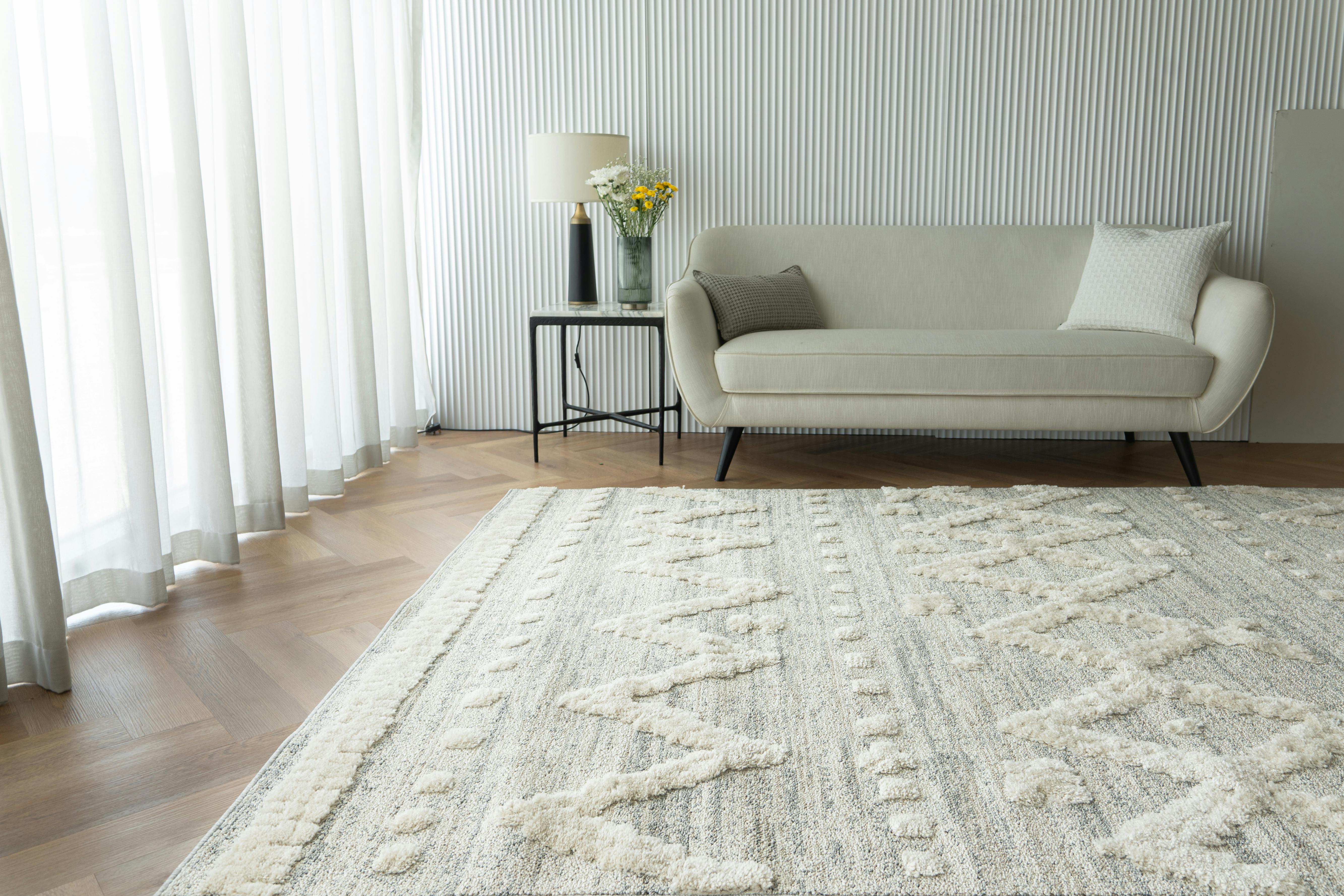 |
| This minimalist design uses texture to give interest and scale to the room (Creative Commons Licensed: https://www.pexels.com/photo/couch-and-carpet-in-living-room-18266460/) |
There is a broad range of choice in carpets, whether loose or fitted, and it can sometimes be a bit daunting especially as it is often quite an investment and is intended to last many years. The first thing to be aware of is the durability: this is especially important in passages, on staircases and in rooms that have a lot of through traffic. Your carpet supplier should be able to guide you through the different grades on offer, but you may need to weigh up cost versus longevity. Choice of colour for high-traffic areas is also an important factor - very dark and very light colours show the dirt, while bright colours show scuff marks. A more neutral colour in a mid-tone is usually the most successful for these spaces.
The next thing to decide is texture: this can range from very smooth to extremely fluffy, the latter usually only appropriate for a bedroom. A bit of texture, where the weave of the carpet is visible, adds to a feeling of luxury, as it is generally associated with the more expensive brands. You can play around with texture and pattern - generally a more patterned design goes better with a smoother texture, while still giving a feeling of luxury.
 |
| Hand-woven rugs have a very distinctive texture, suitable for the larger spaces (Creative Commons Licensed: https://www.pexels.com/photo/rug-texture-28389849/) |
The scale of the pattern should be guided by the size of the room: a large room or an open-plan layout can be enhanced by bold designs, whether an overall repeated pattern, or more pictorial such as a Persian rug or an abstract or geometric design. For a smaller room, I tend to favour texture over pattern, as it is so easy for the room to look overdone - here it is good to use a fitted carpet, or one big enough to allow all the main pieces of furniture to stand on it as a way of unifying the space. In a larger room, you have more flexibility, but be careful of too many small rugs, as this can make the room seem fragmented.
 |
| A carpet with a bold design and striking colours is best suited to a large room (Creative commons licensed: https://itoldya420.getarchive.net/amp/media/carpet-97d783) |
You can also play with pattern to give a perspectival illusion - I have two similar rugs in my bedroom with different size patterns. If I put the one with the larger pattern close to the door and the small pattern further away, it makes the room seem bigger, but if I swap them around, it makes the space seem more compressed. You can also use colour in a similar way - reds and oranges will tend to look closer and blues and greens tend to recede, bold colours jump forward while muted colours seem further away.

Playing with scale to create a perspective illusion
Carpets can be a real asset to most rooms, but I would look to other floor finishes for bathrooms and kitchens. A bathroom has just too much moisture, which can leave a carpeted floor permanently damp. I have a duck-board for my shower and a small bathmat which I place on top - the spaces in the wood allow the mat to dry out thoroughly.
 |
| A bathmat and duck-board rather than a carpet in the bathroom |
A floor finish is quite an investment, so it is a good idea to put in a bit of thought and research - most suppliers can give you samples for fitted carpets which you can take home to see how the colours and textures go with your furniture.
Comments
Post a Comment