
Adaptive reuse of historical buildings

 In one of my blogs last year, I took a visit to the Flower Hall at Wits University which is an award-winning adaptation of an old exhibition building into a stunning exam venue. Today we walk across to the original East Campus, down the hill towards the sports fields, to look at a small gem of a building that has seen several adaptations for vastly different uses.

Approach to the WCCO from the west

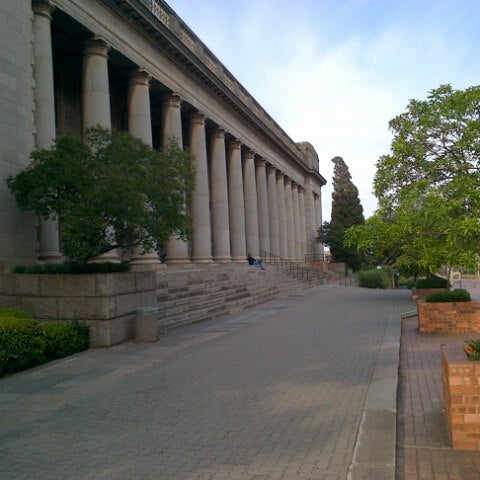
The building started life as a cricket pavilion, designed by the Professor of Architecture, Geoffrey Pearse, who had been appointed in 1922 when the University of the Witwatersrand began. Prof Pearse will be remembered for his publication on Cape Dutch Architecture, the result of a field trip with a group of students who were to play a central role in introducing Modernism to South Africa, including Rex Martienssen and John Fassler. The cricket pavilion, designed in the 1920s, had a symmetrical design, centred on a curved colonnaded verandah facing the cricket field, and crowned with a small turret.

Over the years, the building became dilapidated and was being used largely as a store room and  change rooms for the grounds staff. In the late 1970s, Amancio "Pancho" Guedes, the Head of School of Architecture at the time, was appointed to renovate the building to create a multi-faith prayer space, renamed The Sanctuary. The floor level of the verandah was raised and the verandah enclosed to enlarge the central prayer space. The distinctive "Pancho" wooden skirting  boards with their generous curves, are still visible.

By 2019, the Wits Citizenship and Community Outreach (WCCO) had moved into the building, providing meals for needy students, a food bank and a clothing bank for donated garments. The area around the building has been developed as a food garden to supplement the food donated for the kitchen. The exterior of the building has been enlivened with colourful murals, although the decorative plasterwork at the entrance and the turret have been preserved.

The WCCO entrance from the south

This brings me to a consideration of adaptive re-use of buildings, a topic that is very close to my heart and has played a role throughout my practice as an architect. Wits University has a very good track-record of building re-use, of both its historical buildings and the ones of later date and more ambiguous architectural and historical merit.

An example of one of the older buildings is the original Engineering Building (now called South-West Engineering), that originally housed the entire Faculty of Engineering. Many of the Schools in this Faculty have now been decanted into their own buildings, the first of which was the Hillman Building dating from the 1940s, which houses the School of Civil and Environmental Engineering. The original Engineering Building has been adapted to house the School of Mechanical, Aeronautical and Industrial Engineering on the upper floor, with some sensitive adaptation of the spaces to modernise the lecture facilities. The laboratories for this School are in a separate building to the north.
South West Engineering Building - College Engineering Building in  Johannesburg
Wits original Engineering building, now South-West Engineering
Creative commons licensed: 
https://foursquare.com/v/south-west-engineering-building/4cee6cae51785941a0a2bc8f
The ground floor of the building has been converted into the Registry for the Faculty of Humanities and also houses facilities for their postgraduate students. The enclosed courtyard in the middle of the building at one point had a pipe-organ installed, possibly dating to when the School of Music lived in the east wing of the ground floor. The courtyard is still used for lunchtime concerts - the pipe organ continues to enliven the space and it is an ideal venue for small audiences.

Both of the buildings I have explored here have a number of features in common that lend themselves to adaptive re-use. Firstly, they both have architectural merit and historical associations with the founding of the University, encouraging their preservation and sensitive adaptation. More importantly, they have had "loose-fit" spaces and layouts, allowing them to be modified to very different functions. So often, historical buildings are re-used as museums, such as several of the old buildings in Newtown in central Johannesburg, but this tends to make for a very static and artificial atmosphere, whereas the recycled buildings at Wits have a vibrancy reflected in their active new functions that they serve.

Adaptive re-use is one of the most effective ways in which the construction industry can play its part in becoming more sustainable. New buildings have a huge impact on the environment: often the first step in creating a new structure is to demolish existing buildings, with very little of the demolition waste being recycled and most of it ending up as landfill. New construction materials consume a vast amount of energy in their manufacture, and we need to add in the energy to transport the materials to site. When a building is re-used, far less material is needed, as the envelope of the structure is usually retained, and often the services such as plumbing and electrical layout can often be adapted and upgraded rather than needing to be replaced. All of this contributes to a much smaller impact, and as a bonus, the historical continuity of a place is retained.

Comments

Popular posts from this blog

Welcome to my blog

Sitting outside the Wits Architecture Building My name is Anne. I have just retired from the University of the Witwatersrand in Johannesburg, South Africa where I was an Associate Professor in the School of Civil and Environmental Engineering, working in the environmental engineering and project management domain. Prior to that, I was a lecturer in the School of Architecture and Planning, teaching many aspects of architecture, including architectural history, design and skills in graphics. Before lecturing at the University, I worked briefly in local government as a junior architect and then in a commercial firm of architects. After this I ran a private architectural practice with a focus on architectural heritage design. I have qualifications in architecture, construction management and employment creation through construction. Now that I have retired, I want to continue to provide educational context about architecture, engineering, design and project management in a different forum ...

Pergolas

  While packing to move house, my daughter found some sketches that I had done several years ago for a pergola outside her living room. The room has full-height glazing across the entire width of the east-facing room, making the whole flat very hot in summer. Pergolas are an excellent way of adapting your indoor temperature, especially if you use deciduous plants to cover them, providing shade to the window in summer and letting the winter sun into the room when the plants lose their leaves. They are one of the most cost-effective and environmentally sensitive ways to adapt indoor climate, on any sun-facing side of your home. In the southern hemisphere, pergolas or awnings can be quite narrow on the north side of the building - the sun angle at mid-day is about 70 degrees on the equinoxes, so the depth of the pergola should be about half the height of the window or glazed door so that the sun is not blocked through the winter.  The angle of the sun in summer, winter and at the...

Flower Hall: Wits

As a child, I remember going to the annual Rand Show, hosted by the Witwatersrand Agricultural Society, one of the highlights of which was visiting the Flower Hall - a vast space carpeted from wall to wall with flowers. In more recent times, the land on which the Rand Show was housed was taken over by Wits, the University of the Witwatersrand, thereby doubling the area of the main campus, the original lands of which are immediately to the east. The soaring roofs of the Flower Hall: photo Jennifer Fitchett Wits has retained several of the original buildings, many of which have been retained largely in their original form, such as Hall 29 (used as a basketball venue and doubling up as a large exam venue) and the Wits Club and Alumni House which used to be the wine tasting venue at the Rand Show. Other buildings have their shell retained, but remodelled interiors, and the most ambitious recycling project was the Science Stadium, which ingeniously reused the stadium seating for the large l...